
Disclaimer: This article contains affiliate links. For more details, please read my privacy policy & disclosure.
#1 Use Time Blocking To Plan Ahead
One of the simplest ways to use time blocking is simply planning ahead. Instead of allocating days in your schedule for specific tasks, allocate them for certain times across multiple days if you can. This means you have more variety of tasks in your days and don’t get fatigued by one particular task.

#2 Minimise Interruptions And Distractions
It is important to minimise distractions to get more done with time blocking! Most people are very productive when working alone. It allows them not to be distracted by others around.
Allocate specific blocks of time for checking emails, social media, and other communication tasks. This way, you can work on a task without being tempted to switch tasks or let your mind wander away from the current task at hand.
#3 Set Priorities
It is important to know what priorities are when using time blocking. Are you spending your days juggling multiple tasks, or do you have a set number of things that need to get done every day?
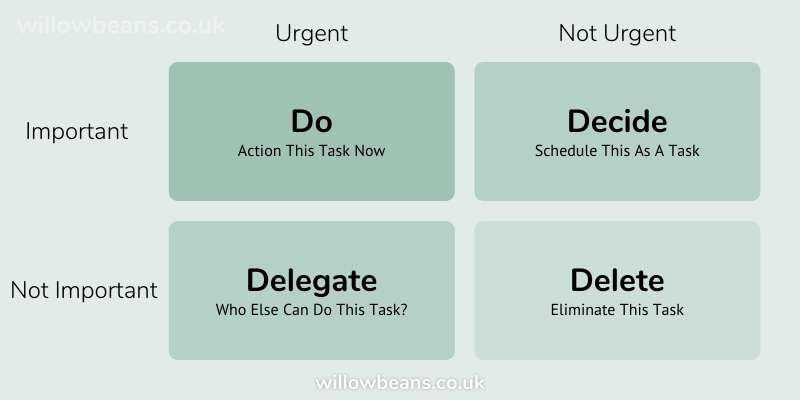
Spend some time determining which items on the list are most pressing and make sure those tasks take priority over other less-important ones. This will help you decide which tasks come first, which get more time than others and which can be delegated to others. Try using the Eisenhower Matrix to prioritise your task list.
#4 Learn To Delegate
If you have a list of tasks that need to be completed, it is important to look at which items can and should be delegated. We don’t all possess the skill sets necessary for every single task on our plate, so using time blocking to differentiate between what we are capable of doing ourselves versus delegating could save us from suffering from burnout.

#5 Not Urgent, Not Important – Learn to say ‘No’
As business owners, it is important to understand what activities are urgent versus which ones are important. We may feel the urge to tackle every task that falls into our lap – after all, there’s no way we could say “no” when someone asks for help or an update on a project they’re depending on you for. However, saying no is an important step in prioritising your tasks.
#6 Be Agile In Your Time Blocking
Look back at each day, summarise what you achieved and what you didn’t, learn from your mistakes and make notes that you can use to guide your time blocking for the next day. Each morning, take a few minutes to figure out what needs to be done – don’t stress about it too much though, as everything doesn’t have to be planned in minute detail.

What happens if something unexpected happens during the day? That’s okay, use the Eisenhower Matrix (see above) to prioritise that task, if it’s urgent and important it needs to be done right away. If it’s not, then place it into your task list for the following day or week as need be.
#7 Bookend Your Day With Firm Routines
Having a regular start of day routine, helps you shift into that productive, ready-to-work mindset. The same goes for the end of the day, have a routine that helps you switch back from your working mindset to a family time mindset.

Finally, if you want to take time blocking one step further and actually manage how much work you are doing each day by limiting yourself – do so! It could help improve productivity levels at the office.

Check out my new Productivity Planner
Each spread includes a daily schedule, top priorities, to-do list and notes. Perfect for both work and personal planning.
160 Pages, 6 x 9 inch notebook
? Pin This For Later

This post was proofread by Grammarly. The World's Best Grammar Checker.
